
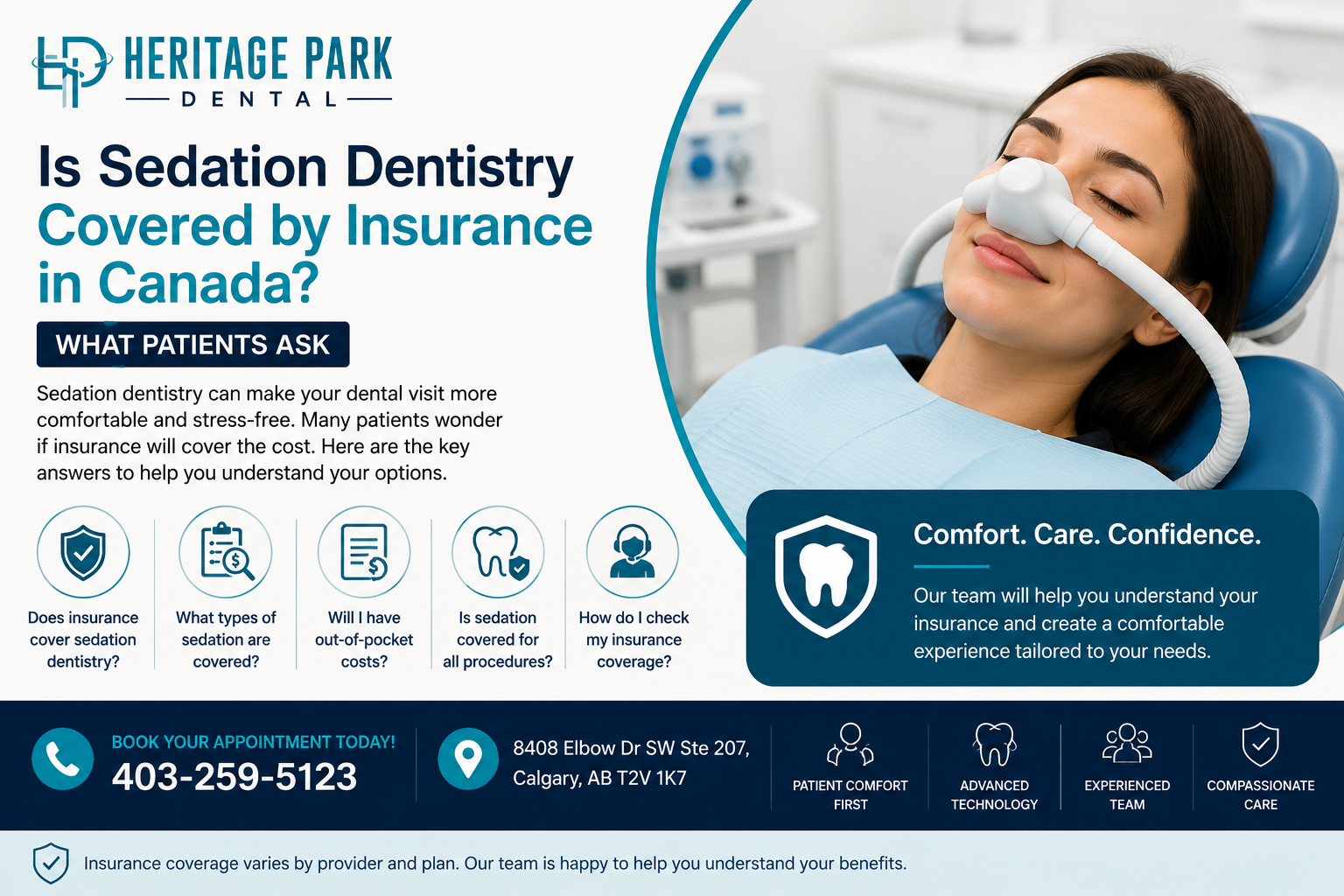
If the idea of sedation at the dentist has crossed your mind, whether because of anxiety, a complex procedure, or past difficult experiences, the next question is almost always the same. Will my insurance cover it?
It is an important question. Sedation dentistry in SW Calgary is available at select clinics, and understanding how insurance works before you book helps you plan ahead with confidence rather than face unexpected costs afterward.
This guide answers the questions patients ask most often in plain, straightforward language.
What Is Sedation Dentistry?
Sedation dentistry uses medication to help patients feel calm, relaxed, and comfortable during dental treatment.
There are several levels available:
- Nitrous oxide—also called “laughing gas.” You breathe it in through a small nose mask. It produces a relaxed, slightly floaty feeling and wears off within minutes of the mask being removed
- Oral sedation — a pill taken before the appointment that makes you feel drowsy and deeply relaxed. You stay conscious but feel very calm
- IV sedation — medication delivered directly into the bloodstream for a deeper level of sedation. You remain in a semi-conscious state and have little to no memory of the procedure afterward
- General anesthesia — complete unconsciousness, typically used for very complex surgical procedures or for patients with severe medical or behavioural needs
Each level is matched to the patient’s needs, the complexity of the procedure, and their overall health history.
Is Sedation Dentistry Covered by Insurance in Canada?
This is the heart of the question, and the honest answer is, “It depends.” There is no single rule across all Canadian insurance plans. Coverage varies significantly depending on your specific policy, your insurance provider, the type of sedation used, and the reason it is being administered.
Here is a general breakdown of how coverage tends to work:
| Type of Sedation | Typical Insurance Coverage |
| Nitrous oxide | Sometimes partially covered—often considered an add-on |
| Oral sedation | Coverage varies widely—some plans cover it, others do not |
| IV sedation | More likely to be covered when medically necessary |
| General anaesthesia | Often covered for surgical procedures or special needs patients |
The key phrase that appears again and again in insurance decisions is medically necessary.
What Does “Medically Necessary” Mean for Sedation?
Insurance providers in Canada tend to approach sedation coverage through the lens of medical necessity. If sedation is required for a patient to safely receive treatment due to a diagnosed anxiety disorder, a physical disability, a cognitive condition, a severe gag reflex, or a complex surgical procedure, the case for coverage is stronger.
If sedation is chosen primarily for personal comfort rather than clinical necessity, many insurance providers will either partially cover it or decline coverage entirely. This does not mean comfort-based sedation is not valuable; it absolutely is. It simply means the insurance outcome may differ depending on how the need is documented and coded by your dental clinic.
What Factors Affect Whether Your Sedation Is Covered?
Several specific factors influence how your insurance provider handles a sedation claim:
- Your insurance plan type — employer-sponsored group plans, individual plans, and government-assisted plans all have different frameworks
- The type of procedure being performed—sedation for an extraction or oral surgery is more likely to be covered than sedation for a routine cleaning
- Your documented medical or psychological history—a formal diagnosis of dental phobia, anxiety disorder, or a medical condition affecting cooperation significantly—strengthens a coverage claim
- The sedation method used—nitrous oxide is the most commonly covered; general anesthesia has the clearest pathway for coverage in surgical contexts
- Your specific policy wording—some plans explicitly list sedation coverage; others leave it to case-by-case adjudication
- Pre-authorization — some insurance providers require approval before the procedure takes place, rather than reviewing it as a claim afterward
Should You Get Pre-Authorization Before Your Appointment?
In many cases, yes, and this is one of the most practical steps patients can take.
Pre-authorization means contacting your insurance provider before your appointment to ask directly whether sedation is covered under your plan for your specific procedure. You get a clearer picture of what to expect financially before any treatment begins.
Here is what to ask your insurance provider:
- Is sedation dentistry covered under my current plan?
- What types of sedation are included: nitrous oxide, oral, or IV?
- Does coverage depend on the procedure type or medical necessity?
- Is pre-authorization required before my appointment?
- What documentation from my dentist would support a coverage claim?
- Is there a maximum dollar amount covered per year?
Getting these answers in writing or at least noting the date, time, and name of the representative you spoke with protects you if a dispute arises later.
What If Your Insurance Does Not Cover Sedation?
Not having coverage does not mean sedation is out of reach. Many patients choose to pay for sedation out of pocket because the benefit to their comfort and treatment experience is worth the cost.
Some practical options to explore:
- Flexible spending accounts or health spending accounts—if your employer offers one- sedation costs may be eligible
- Payment plans—many dental clinics offer financing or payment plan options that spread the cost over several months
- Prioritize procedures—if cost is a concern, discuss with your dentist which procedures genuinely require sedation and which could be managed with other comfort measures
- Nitrous oxide is a middle ground—it is typically the most affordable sedation option and is suitable for many patients with mild to moderate anxiety
A dental clinic near you that offers transparent pricing will always walk you through costs upfront so you can make an informed decision without pressure.
Questions to Ask Your Dental Clinic Before Booking Sedation
Your dental team is one of your best resources for navigating the insurance question.
Before confirming your appointment, ask the clinic:
- What types of sedation do you offer?
- How do you document sedation for insurance purposes?
- Can you provide a predetermination letter to submit to my insurance before treatment?
- What is the out-of-pocket cost if my insurance does not cover sedation?
- Do you offer payment plans for patients whose sedation is not covered?
A good dental clinic in SW Calgary will answer these questions clearly and help you understand your options before you commit to anything.
Who Should Seriously Consider Sedation Dentistry?
If any of the following apply to you, sedation dentistry is worth exploring regardless of whether insurance covers it:
- You have significant anxiety or fear about dental visits
- You have had a traumatic dental experience in the past
- You require a lengthy or complex procedure
- You have a strong gag reflex that makes treatment difficult
- You have a physical or cognitive condition that makes cooperation challenging
- You have been avoiding dental care for years because of fear
For many patients, sedation is not a luxury; it is what finally makes dental care possible. And in those situations, the value it provides goes well beyond what any insurance calculation can capture.
Get the Answers You Need: Heritage Park Dental Is Ready to Help
Navigating dental insurance questions can feel confusing, but you do not have to figure it out alone. The right dental team will take the time to explain your options, help with documentation, and make sure you understand what to expect before any treatment begins.
We want you to feel like you are in capable and truthful hands with everyone on staff at Heritage Park Dental, no matter what. You may have questions about how sedation is covered, you may be looking for ways to make a dental visit more comfortable, or you may be simply at the point where you are finally ready to schedule the appointment you’ve been putting off. It’s okay!
Get in touch today to start receiving a dental experience you can feel good about.
Frequently Asked Questions
Q1: Does every dental insurance plan in Canada include some sedation coverage?
No, sedation coverage varies significantly between plans and providers, which is why reviewing your specific policy and contacting your insurer directly before your appointment is so important.
Q2: Can my dentist help me get sedation covered by insurance?
Yes, your dentist can provide documentation, predetermination letters, and procedure codes that support your insurance claim and improve the likelihood of coverage being approved.
Q3: Is nitrous oxide the easiest type of sedation to get covered?
Nitrous oxide is often the most accessible entry point; it is the most widely used dental sedation option and is sometimes partially covered, though this still varies by plan.
Q4: What if my insurance claim for sedation is rejected?
You could ask the dental clinic to submit more documentation to justify medical necessity or to formally appeal to your insurance carrier, or consider if a health spending account can be used to pay the cost.